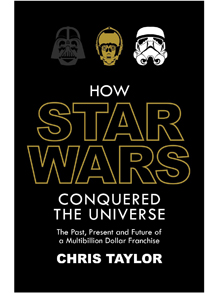
Pal Seamus was reading this book when I went to meet him one evening in Larchmont Village. Even though there were other books in my queue, hard to resist a book about Star Wars. Not that I have much love for the franchise – people’s reactions to it make me shake my head in bemusement and back away slowly. [ref]while growing up, some people distinguished between Star Wars and Star Trek as the series with the tube-light lights and the series with Mr Spock. Star Trek played on Doordarshan in 1985, a year before we bought our first TV, so I bypassed that too. But there were kids in school who would pinch you really hard on the back of your neck, because Mr Spock. [/ref]I suspect the most invested I was in the series was while reading a bunch of Star Wars novels about 10 years ago, specifically The New Jedi Order series, which begins with the death of Chewbacca in the first book. Don’t worry, this is not really a spoiler, none of the books are canon anymore, especially with The Force Awakens and the planned one-Star-Wars-movie-a-year releases. Just so you know, this book talks about that happening too, with the kind of cold-blooded objectivity that sends shivers down your spine.
When fan grief over the death of Chewbacca surpassed anything Shapiro or Stackpole expected, a rumor surfaced that Randy Stradley of Dark Horse Comics had told the meeting to “kill the family dog,” and compared Chewie to Old Yeller. But Stackpole denies that, insisting they all stuck the knives in at the same time, like Roman conspirators. Shapiro, who would edit the book, was happy to wield a blade. “You’ve got to get people’s attention. Otherwise it’s just ‘Oh, another adventure, another super weapon,’” Shapiro explains.
Why the interest in this book then, you ask? Because the behind-the-scenes affairs with the series has always fascinated me. Stars Wars’ tendrils encompass a lot of sci-fantasy pulp fiction, old-school Hollywood space operas, and world cinema. Alex Raymond and Akira Kurosawa, EE Doc Smith and Edgar Rice Burroughs coming together in a cultural bouillabaisse that is timeless and appealing to multiple generations, clunky dialogue be damned. Lucas, an avowed non-writer, worked his way through anxiety and budgetary nightmares to try and bring back to life his childhood fascination with film serials; to deconstruct what made his heart soar in a darkened movie theater. And – pardon my mixed pop-cultural metaphors – he even went boldly where few screenwriters had gone before, tapping into primal myths and stories, specifically the themes and archetypes that writer Joseph Campbell identified in his seminal works. For me, knowing about Star Wars was much more enlightening than watching the movies. [ref] Here’s a confession: I saw the first 20 minutes of Empire Strikes Back when I was 11 or 12, and did not make sense of it, obviously. I have vague memories of watching one of the Ewok movies a year later, and that was a cutesy experience where storytelling did not matter. I saw New Hope in my second year of college, shaking my head over the outdated effects at the end but letting myself be sucked into the world. Then came the prequels, and much as I enjoyed them in the theater, the relentless barrage of wtf-ery in both plot and dialog overpowered the love of the world Lucas created. Yes, I have never seen Return of the Jedi. [/ref] That’s why I jumped on this book immediately.
Also, turns out Campbell had nothing but good things to say about Lucas, who met him later in life and befriended the academic:
“I was really thrilled,” Campbell said of the Star Wars series in a later interview. “The man understands the metaphor. I saw things that had been in my books but rendered in terms of the modern problem, which is man and machine. Is the machine going to be the servant of human life? Or is it going to be master and dictate? That’s what I think George Lucas brought forward. I admire what he’s done immensely. That young man opened a vista and knew how to follow it and it was totally fresh.”
The book opens in a wonderful manner, a screening of Star Wars dubbed into Navajo, where the writer tries to find Star Virgins, people who hadn’t seen any of the movies before. He spirals out into how pervasive the movie’s references have become, and how it is very hard for anyone at all to come into Star Wars with a blank slate. (If I remember right, someone did a Star Wars virgin watch on Twitter recently.) Alternate chapters of the book talk about fandom and the weird ways in which everyday lives of people have been affected by the movie. I had no idea, for example, that light-saber classes existed:
The easiest way to describe light-saber class is that it’s one part fencing, one part yoga. The goal is to learn a numbered system of fight choreography worked out by Bloch and his co-founder Matthew Carauddo, who runs the same class in a studio in Silicon Valley. You and I could meet for the first time with our light-sabers at a Comic-Con, say, and I could utter a string of numbers and you would know that I was going to slice around your body in a star formation and parry appropriately. We could even throw in flourishes such as the figure eight, or something more elaborate Bloch calls the “Obi-Annie” (but which is actually a move called “plum blossom” from the martial art Wushu). We would for one moment shed our nerd shells; we would look cool.
Or that the imperial storm-troopers you see at conventions are part of an officially-endorsed Stormtrooper legion created and managed by loyal fans, called the Fightin’ 501st. They later went on to be name-checked and referenced both in novels (Timothy Zahn’s Survivor’s Quest) and in the prequels, though in an ill-fated turn of events, they will forever be known as the baby-jedi killing storm-troopers.
It was, friends agreed, a pretty neat idea. They helped him hand out leaf-lets at conventions: “Are you loyal? Hardworking? Fully expendable? Join the Imperial 501st!” In 2002, Johnson mustered roughly 150 Stormtrooper costumers in Indianapolis at Celebration II, the second official Star Wars convention, and offered their services to a skeptical Lucasfilm to let the 501st help out as crowd-control when the event’s security proved woefully inadequate for the thirty thousand attendees. Lucasfilm was won over by the tireless, hyper-organized troopers, and started to use the 501st as volunteers for all its events. Lucasfilm licensees followed suit. If you’ve ever been to one of the Star Wars Days held at dozens of baseball stadiums across the United States, if you’ve seen multiple Stormtroopers, or Darth Vader or Boba Fett at a store, a movie theater, or a mall, you’ve almost certainly been staring at the forces of the 501st.
The 501st Legion is now recognized as one of the largest costuming organizations in the world. It has active members in forty-seven countries on five continents, divided into sixty-seven local garrisons and twenty-nine outposts (those units that comprise fewer than twenty-five members). More than 20 percent of the troops are female. The 501st absorbed a once-independent UK garrison and established a garrison near Paris, though some French Stormtroopers have gone their own way with the 59eme legion. The Germans, meanwhile, have a garrison consisting of five squads that are all large enough to be garrisons on their own—but are loath to undergo any kind of de-unification.
Swooping into a quick history of Lucas’s childhood and influences, the book talks about his early avant-garde career – one of his acclaimed student films, for example, was comprised entirely of panning shots of photographic images with music playing in the background. The takeaway is that Lucas always had ideas, but they were unconstrained by any Hollywood pretensions – the three-act screenplay was not for him, until American Graffiti came about. The nugget there is that the name did not quite appeal to the studio bosses, because the word “graffiti” was not in popular usage then.
It sounded odd to contemporary ears. The Italian word had not yet gained common currency. New York subway trains were about a year away from being covered in spray-painted signatures. Lucas hadn’t intended that debased usage of the word in any case; he meant the word invented at Pompeii in 1851 that means nostalgic etchings. He wanted to record the legacy of a lost decade: an American Pompeii, frozen in time forever.
Lucas tried to follow up this success with options of Dune and Flash Gordon. Producer Dino DeLaurentiis happened to get Flash, and Alejandro Jodorowsky got hold of Dune. Flash Gordon ultimately got made as a campy pastiche in the early 80s, while a different version of Dune made it to the screen. The book talks about trippy possibilities that the latter presented, and this reminds me that I need to check out the documentary soon:
Jodo, appropriately enough for Dune, was something of a cult leader himself. He persuaded the great Orson Welles to act as the villain of the piece in exchange for hiring his favorite Parisian chef, and even managed to hector Salvador Dali into agreeing to a cameo as the Emperor of the Universe (for $100,000 a minute, Dali insisted). He got the Swiss artist H. R. Giger, possibly the only person in Europe weirder than Jodo and Dali, to do a bunch of nightmarish concept paintings, and recruited French comic book artist Moebius to storyboard the entire film at lightning speed.
Most of the making of the actual Wars movies was not new to me. Too much have already been written about the process, and the different iterations of the first movie’s screenplay that Lucas banged out. One thing however stood out, the short-lived gender reversal of the lead character, a telling choice for a series that has been plagued with gender/race allegations until the recent sequel. Think of what might have been.
In March 1975, Lucas decided to fix that at a stroke: Luke Starkiller became an eighteen-year-old woman. After all, he’d been reading an awful lot of fairy tales as research into the mechanics of storytelling, and it’s rather hard to ignore the convention that the protagonist of fairy tales is almost always female. (Think Cinderella, Rapunzel, Snow White, Red Riding Hood, and Goldilocks—as much as they have to be saved by princes or woodcutters, we at least see the story through their eyes.) This gender reversal lasted for a couple of months, long enough for the female Luke to show up in a McQuarrie painting of the main characters.
The discussion becomes much more entertaining with the movie’s release. Taylor goes into an inspired examination of the first few words on the screen – words that apparently were rewritten at the last minute by Brian Coppola to lessen the original verbosity.
Consider instead that this is exactly what every fantasy epic needs to give you right off the bat: a setting in space and time that says, relax. Don’t bother trying to figure out the relationship between what you’re about to see and your own Earthbound reality, because there isn’t one. This isn’t Planet of the Apes; the Statue of Liberty isn’t going to turn up in a last-reel twist. No other movie had ever announced its divorce from our world so explicitly before; with the exception of Star Wars sequels, none would ever be able to do so again without seeming derivative. The perfect simplicity of those ten words appears to have been hard for a lot of people to understand in the run-up to the movie’s release. The words that open Alan Dean Foster’s novelization (“another galaxy, another time”) aren’t quite the same—that might place us in the future, rather than in a story that is safely in some history book. Fox didn’t get it at all: its trailer for Star Wars opened with the words “somewhere in space, this may all be happening right now.” The ten words remain on the screen for exactly five seconds, long enough for the casual viewer to think, Isn’t this supposed to be a science fiction movie? Aren’t they all set in the future?
It is this modern myth, that of how the Star Wars machine became what it was, in the first weeks and months after the release of the first movie, that the book really captures so very well.
In May 1977, repeat viewers didn’t necessarily add to the ticket gross: they could simply stay in the theater, wait an hour or so, and watch the movie again. This was not something viewers had tended to want to do before. Indeed, it was because of Star Wars that most cinemas instituted a policy of clearing the audience out of the theater between shows. But as soon as they left the theater and came back, the repeat viewers were responsible for an incalculable amount of box office takings. For many—and this is something you see time and again in television and newspaper reports from 1977—the number of times they’d seen Star Wars took on the tone of a competitive sport: “I’ve seen Star Wars twenty times!” But for many more who weren’t quoted by the news media, it was simply a thrill to invest themselves in a story with such eminent repeatability. You could see it twenty, thirty, forty times and not get bored.
***
The manager of the Coronet, a cranky old soul named Al Levine, had never seen anything like it. He offered a now-famous description of the crowds: “Old people, young people, children, Hare Krishna groups. They bring cards to play in line. We have checker players, we have chess players; people with paint and sequins on their faces. Fruit eaters like I’ve never seen before, people loaded on grass and LSD.”
***
In June 1977, the monster crowds at the four theaters in New York showing the film each required police on horseback for crowd control. All walks of life rubbed shoulders in those lines. Johnny Cash, Muhammad Ali, and Senator Ted Kennedy waited at their theaters like everyone else. Elvis Presley tried a different tack; the King was in the process of securing a Star Wars print to screen for himself and Lisa Marie at Graceland the day before he died.
***
In May 1977, the most popular poster in America was an image of Farrah Fawcett, chief Charlie’s Angel, in a bathing suit, with a noticeably aroused nipple. By July, Star Wars posters were outselling Fawcett five to one.
***
Toy sales came to the rescue. Despite the movie no longer being in theaters, despite the disastrous Holiday Special, and against all expectations, Kenner announced that it had its strongest holiday season yet. Sales of Star Wars action figures, spaceships, and play sets had crossed the $200 million mark, funneling more than $20 million into Lucasfilm subsidiary Black Falcon. Without that cash injection, there’s little question Empire would have been sunk. There’s something poetic about it: millions of children joyfully acting out the further adventures of Luke Skywalker literally funded the further adventures of Luke Skywalker. Call it a karmic Kickstarter.
It’s funny how Taylor blazes through the three prequels all in one chapter. Star Wars fans from the New Hope generation are so predictable.
All in all, the book was an excellent read; it did make me want to re-watch (or watch, in case of Jedi) the original movies, and put in pieces of the Star Wars history that were missing from my understanding of the history of the seminal series, especially the debt Lucas and Co owe to concept artist Ralph McQuarrie, whose designs really helped sell the movie to both Lucas’s friends, his team and studio heads. My dismissive tone about the series is at odds with my fascination for its metadata, as you can clearly see. I know the technical details of where the sound of Wookie comes from (‘a bear starved in a zoo and then shown a bowl of milk outside the cage’, for your information) or how Lucas made a note when someone asked for Reel 2, Dialog 2 in the editing room of THX 1138, or the story behind how Han Solo’s sprezzatura in saying “I know” came about. I can also appreciate how it probably is the only bit of mythology that America can truly call its own. The person sitting next to me at the morning screening of the Force Awakens cried a few times as the movie played. My local comic-book shop (and others) had large “Star Wars Spoiler Free Zone” signs up the first two weeks of release. All I wonder is how long this reverence will continue to play out. A major part of Star Wars is to do with how little we know about the Star Wars universe and its details – and it only takes a few years of misbegotten scripts to run a special thing into the ground, to turn a mythic tale into something mundane.