Three songs

Leslie Feist - Mushaboom

Jussi, an old old friend - not in age, mind you, but someone who goes back quite a few years - flew over from Helsinki to come meet me in Cluj, Romania. We had planned a road-trip towards the Carpathian mountains, all the way to Castle Bran - otherwise known as ‘Dracula’s Castle’, and as soon as the man arrived, friends from the office helped us find a rental car agency, where we had to decide between a Volkswagen or a BMW. Jussi and I looked at each other, and he asked the question that was on my mind - “Do they have music systems with auxiliary inputs?” Well, the question on my mind was actually - “what color is the BMW?”, but I had to agree with my friend - priorities are priorities, and no self-respecting road tripper would venture out without ensuring that the car is well-equipped in terms of audio paraphernalia.

The Volkswagen had a CD system - “Plays MP3 CDs”, the person at the rental centre assured us. No auxiliary jack, though. The BMW had squat. Decisions having made, I  spent some time that night - after having imbibed quite a few glasses of wine ( I claim 7, others say 6) - burning an mp3 CD. And the next morning, as we started on our journey, we popped the CD in, waited for the music to play and then, nothing.

The music system only played audio CDs, goddamnit.

We burned two CDs on my laptop while having breakfast at a motel. One didn’t work, the other did. Wrote 4 more CDs in a hotel that night, 2 didn’t work. And finally, the next day, we burnt three more CDs, out of which one worked. That last CD included the song that Jussi had been trying to play for me the last few days. Leslie Feist’s Mushaboom.

On the last leg of the trip, the GPS on the car - the way to Cluj from Bran Castle - took us through a route that took us through a forest, and gave us a clear view of the mountains. There was not a single car to be seen, and the sun broke out of the clouds at brief intervals, but the overall atmosphere was that of complete serenity save for the open road in front of us. It was at that magical moment, when the two of us were more than a little tired from the trip, and a wee bit melancholic about the end of a good vacation, that Mushaboom began to play on the music system. And it’s because of that I’ll associate the song forever with autumn evenings, the Carpathian mountains and the open road.

The video was another source of joy when I saw it much later, making me feel giddy with laughter. Bacon bat wings, whee! Flying guitars! Empty carnival grounds, which are usually creepy, but suddenly seemed fuzzy and nice and welcoming.

Katie Melua - 9 Million Bicycles

So when I played Mushaboom to a friend in Romania the week after Jussi left, she asked me - “Have you heard Katie Melua?” I hadn’t. That was remedied within a few minutes, and as the strains of the Chinese flute opened ‘9 Million Bicycles’, the first song in Melua’s ‘Piece By Piece’, I almost held my breath and waited for the song to disappoint. Happily, it didn’t. This was one of those rare songs whose lyrics I paid close attention to during the all-important first listen, and smiled along to the references to light-years and the world’s population. Her voice is a combination of Norah Jones and Joss Stone, and the production in the album just quirky enough not be repetitive.

Later on, I learnt that Melua’s song invoked the ire of science guru Simon Singh, because of the line “We are twelve million light-years from the edge, that’s a guess” - and she apologized by coming up with a witty rephrasing of the stanza, which you can see in the snippet of video below.

Regina Spektor - Fidelity

And there are the songs that just come to you, flying out of nowhere just when you think you cannot be surprised anymore. A friend at the office enjoyed the two songs I played for him - no prizes for guessing which ones they were. He created a last.fm profile for himself, and as he was listening to my station, he asked me if I had any Regina Spektor songs. I did, and the next day, I loaded up his iPod with all the albums I had.

Last night, I sat down near the laptop, and the only music I had on the drive  ( it’s the office machine, and I don’t keep music on it, as a matter of principle. Also because it’s only 80 GB) was the aforementioned Spektor albums. I put on the first song from Begin To Hope, which happened to be ‘Fidelity’. I had heard the album before, a long time ago, but the way the song infiltrated my senses - at that precise moment - was unbelievable. Pizzicato strings, piano tinklings and Spektor’s voice kept me company for quite sometime. It’s still the only song I’ve listened to all day, and I have no doubt it will keep me company all of tonight.

And now I wonder - which song lies in wait for me next, ready to be discovered? What memory will I associate it with, and who will I think of when I listen to it?

The making of a theme round

(Note: If you are reading this on a feed-reader and you don’t see the Slideshow embedded into the page, you should probably click on the actual post link and read it first. Trust me.)

Every time I am done with a quiz, in addition to the ‘thank you’s and the ‘great show’s that come my way (and the occasional “you call that a quiz?”), there are a few individuals who ask me - “How do you come up with the questions?” Unfortunately, the moment just after the quiz is also the precise instant the adrenaline rush is wearing off, and you realize that you’ve been on your feet for a few hours, and your throat hurts like mad from speaking a little too loud. So the typical answers come out - “I read, and I watch movies, and sometimes the questions just come to you.” Which is all true, but does not really cover the mechanics that go into making a quiz question “sing”, to use a metaphor badly.

While I will go into details of making a quiz question - my personal experience of it, that is - in a future post, I thought it would be nice to write about one round in particular, of a quiz I did this weekend. Why this quiz, and this round, you ask? Well, because I came up with the idea of the theme, and the questions, in about an hour or so, on Saturday morning, when my flight to the venue - IIM Ahmedabad - was just a few hours away. I normally do not cut things so close, but the joys of late-night intercontinental conference calls forced my hand, alas. But the positive part of it was that coming up with this round left me feeling very pleased with myself. It was an India quiz for Nihilanth, the inter-IIT-IIM quiz-fest. Until a few days ago, I had thought about including a theme involving Kamal Hassan movies - which turned out heavily South-India oriented and I dropped the idea. Not all quizzes need theme rounds, so I gave up the idea and focussed on a round made entirely of connect questions.

Somehow I got to reading about the Bharat Ratna - and the part about living recipients caught my eye. Voila, six people, and all of them quiz-worthy individuals. I had the answers to my theme questions, all I needed now were the questions themselves.

Now here’s a confession - every quiz I work on does its best to transform itself into an entertainment quiz - making it almost a matter of pride for me nowadays to keep the ent questions to a minimum. Considering that I was running short of time, and because the quiz was otherwise balanced enough  - and, heh, to add a little misdirection, I thought about making the questions ent-based. So the first question became the most obvious one - Lata Mangeshkar and her brief career as actor and music composer. Old chestnut, phrased in a gender-neutral way, with the answer directly connecting to the theme.

Now the second question in the theme is important, because as soon as the first one is answered, the participants are processing multiple possibilities to which the first answer can relate. An obvious answer, and you find your theme cracked in the second question, and one does not want that, really. So, instead of going with Amartya Sen directly, the question became about his daughter. The answer “Raja Ravi Varma” was completely unrelated to the theme ( as I would inform the participants as the quiz progressed), but hey, you could see Nandana Sen in the poster.

For the third question, I had multiple options - there was the one about Ravi Shankar having “remixed” Saara Jahaan Se Accha for the Doordarshan theme music, there were possible Beatles questions, maybe something about Anoushka Shankar ( the thought of which I ditched immediately, because two father-daughter connects would have been a bit too much ). Maybe something about the Grammies, because of the recent Indian nominations? But then a little serendipity came into play - just that morning, I had heard Nitin Sawhney’s soundtrack to The Namesake, and I remembered reading his comment Shankar’s soundtrack for Pather Panchali on the Guardian’s Top 50 OSTs list. Brief googling and yes, I had the precise context, and I remembered that I also had the PP soundtrack somewhere as part of another album. Couldn’t find it, and decided to play one of The Namesake tracks instead. Another question down.

Nelson Mandela’s question was straightforward - though there was the brief temptation to hunt for the comic that was made on his life and ask something on it. But Invictus was more relevant, it had just come out last December and was an Oscar contender. Since it was based on a book, and the book was not called Invictus, there you go. Straightforward, slightly long-winded, mostly-guessable question.

With Kalam, I was completely out of ideas. Time was running out, and I had absolutely no desire to go looking for his poetry or quotes from his books - there is a Rahman song written around his lyrics but again, too much work. So settled for reading his Wikipedia entry, and hell yeah, his Hoover medal, how did I forget that? Done, and sorry, I knew it wasn’t ent-oriented, but there’re compromises a man’s gotta make when he’s running out of time, and this was one of them.

Which left us with the last question, the one on Pandit Bhimsen Joshi, and I didn’t have to think twice. The first question of the preliminary round of the quiz was - “What was the first instrument seen on the video of Phir Mile Sur Mera Tumhara?” It was only fair to have the last question of the quiz to be about the original Mile Sur video, and yup, it made me happy to end the quiz on that note. One might argue that my quest for closure in my quiz made the last question too easy. But two points you have to understand - at this point of the quiz, there would be the people who had already cracked the theme, so chances that they knew the answer already was very high. And this being a college quiz, the percentage of the demographic who had seen the original video of Mile Sur was, in my opinion, very low.

Endgame: So, did it work out the way I had planned? Not really. For starters, mentioning that the theme was exhaustive kept everyone guessing. As expected, the second question proved misleading enough. But the unforeseen problem-child was the Pather Panchali question, which had everyone thinking Satyajit Ray instead of Ravi Shankar - a train of thought I had …uh…neglected to take into account. Obviously Ray was also a Bharat Ratna recipient, but one very much dead, defeating my theme squarely. It had participants guessing things like ‘people who received highest civilian awards from multiple countries’, or ‘Indians who have won the Legion d’Honneur”. Oh well, they did get it at the end, but in hindsight, I should probably have mentioned Ravi Shankar as the connect, would have made things much easier.

So there you go, an insight into how a theme was made. Not my favorite bunch of questions, and not the greatest theme of all time, but a quick and dirty way of doing it. Mind you, going in reverse is not the only way to go about creating a theme round. Maybe I will talk about the other way in another post, or maybe this post will get some proper quiz-masters to talk about the mechanics of creating a quiz on their blogs.

On Bill Watterson

After a long, long time, Bill Watterson, creator of Calvin and Hobbes, has responded to an interview. Watterson, for those in the know, is a reclusive creator who prefers to spend his time away from the public adulation that came his way because of his strip. His ten years of newspaper cartooning ended with a self-imposed retirement, and along with his decision to end Calvin and Hobbes at that time, he also took the decision to not allow his strip and its characters to be used for merchandising of any sort, with the exception of collected book editions - the best-known of which was The Complete Calvin and Hobbes, the massive hardcover collection of all the C&H strips, published by Andrews McNeel in late 2005. I believe the last interview he gave was in association with that volume’s release, where he replied to questions from fans from all around the world.

This particular interview does not cover any new ground into understanding Watterson, his craft or his future plans. The questions that the interviewer asks are mostly to do with what the artist feels about his creation and its legacy after 15 years, his relationship with his fans, and his thoughts on his self-imposed exile from the comics world. Not surprisingly, almost all his responses are in tune with what he’s said earlier, with a wash of dry humor here and there. The only time we see a flash of hubris is in his concluding words about how he wants Calvin and his tiger to be remembered - “I vote for Calvin and Hobbes, eighth wonder of the world”. But knowing the way journalists invent soundbytes, or parting lines, I wouldn’t be surprised if these exact words were never uttered. Yep, we’ll never know for sure.

This link was posted in a forum I frequent, and some listers were quick to point out that  Watterson seemed to be a little holier-than-thou with his principles, and very disinterested in his fans. There were also comments made about the fact that he’s shown fans of his art two raised middle fingers by donating all his art to the Ohio State University - yes, that’s an original art forum, and people do get very testy about lost art opportunities.

Obviously, I do not agree. I do not find anything in the interview ( or the interviews of his that I’ve read so far) that says Watterson is repulsed or does not care for fans. He’s honest about the strip - he put a lot of effort into it and is thankful readers appreciate it, but he does not want to capitalize on its success. There’s a bit of self-deprecating humor to what he says ( the comment about the groupies) but distaste? Not really. Again, speaking from personal experience, most people around me are crazy about C&H. Sometimes to such an extent that they are willing to quote chapter and verse and punchline from random strips during conversations. Hell, forget the creator, *I* am a little uncomfortable with the philosophical/life lessons they seem to find in their umpteenth reread of C&H collections. ( And that, in all honesty, is one of the reasons I choose to downplay my personal love for the strip, just because I do not want to be counted as part of this brigade. So sue me!) I cannot blame Watterson for being realistic and moving on with his life - his work is done, and he does not want to be a rock-star living off anniversary reunion performances. Good for him!

I think that the lack of merchandising and pop-culture-bombardment is what has contributed to C&H’s enduring popularity. I don’t know about others, but seeing images of characters from Garfield , Dragon-Ball Z, Charlie Brown, Dilbert, (insert popular strip here) has this disconcerting effect of making them all seem overly familiar. Speaking from personal experience, with all the merchandised strips, there are multiple inlets to discovering the original - “oh yeah, I saw it on a t-shirt/tv show/calendar, so this is a comic? Never knew!” And by that time, the effect of discovering something completely fresh and new is offset by this superficial familiarity. In case of C&H, the only way to discover it, and to get into it, is to stumble onto the strip, and this elevates the effect the comic has to the first-time reader. Unlikely or not, it seems like Watterson was smart enough to think of, and maintain C&H as a comic and nothing else, and this has helped his creation in the long run.
Another thing that I appreciate about the man is that he’s been consistent with his principles all throughout. The act of donating his original art to Ohio State University is in line with the artist’s personal viewpoint. The strip will always exist, and his gesture ensures that the art used to create C&H is not a commercial commodity ( yet! I sincerely hope someday some part of it comes to the market, and hopefully by then my coffers would be brimming with green). Other artists have done it - Jeff Smith, for instance, and if I understand right, Steve Bissette plans to make a donation of his existing Swamp Thing art and preliminary art to a museum. Nobody will own it, and everybody will have a chance to look at it, provided they make a trip to Ohio. Fair enough.
That said, I sincerely hope Watterson someday figures out that he has another creation inside of him, something that can be completely unlike C&H, and yet a worthy successor. It does not even have to be a comic, actually - maybe a book, or some fine art, or even a musical album. The world needs more great art, and Watterson is an artist’s artist, a rare breed today, and by Cthulhu, it feels good to have someone like him still exist.

No Rahman For A Year

I turned 30 last year, and I realized that for the last seventeen years of my life, AR Rahman’s music has been a constant companion to virtually everything I’ve done. It was what converted me from a casual listener to a rabid music enthusiast, and it is to this music that I map most memories of growing up, my college years, a lot of significant events of my life. Every Rahman release would be ( and still is) a mini-event, the only thing beating it would be the anticipation of what would come after this one. While I cannot confess to having listened to *every* song produced by him, the number comes very close to his complete output.

But hey, seventeen years is a long time, man. While there was a time that I listened exclusively to his music alone, it also got me to sample new composers in the Indian film music scene, and even go beyond my comfort zone and try out different genres - Qawwali, world music ( I remember hunting down and buying Peter Gabriel’s Last Temptation of Christ just because it was recommended by Rahman, in a Filmfare interview, then the only way to keep track of what was on the cards for the next few months for the Rahman fix), good ol’ rock and roll, ambient music, EDM - and lots and lots of soundtracks.  And while my tastes in other genres and kinds of music has morphed and evolved in various directions, I find my predilection for Indian music often gauged by the strict barometer of the standard laid down by Rahman. (And not just Indian music, mind you - there is an instant liking to some international artistes based on how Rahman-like their music sounds on the first hearing - Vanessa Carlton’s ‘A Thousand Miles’ comes to mind, as does Owl City’s ‘Fireflies’ ) Which is to say that, every new composer or artiste I listen to has to stand up in a podium while I, with my halo of Rahman-love shining brightly over my head, pass judgement - the result is more often than not a thumbs-down.

Last December, while walking through the streets of LA, the album that played in my ears was Nirvana’s MTV Unplugged. Now this is another of those college-level albums that was internalized to such an extent that I could not only sing along to all the songs, once upon a time, but also murmur the words that Kurt Cobain says in between song. True confession, I would do that, and even laugh along with the studio audience. During boring classes, I could play the album in my head all the way through - ah well, you get the picture. It was an album that I heard so much that after some time, I realized that I need not listen to it again ever again. And I didn’t, for quite some time - I remember hearing it again sometime in 2003 or 2004, and then relegating it again to the “been there, enjoyed that, time to move on” pile. But listening to it this December was a revelation. I frequently found myself being surprised by which song followed another, I could not remember most of the lyrics, and Cobain’s dry banter between songs actually had me smiling not by force of habit, because I found them genuinely funny. Needless to say, I loved that feeling.

So the deal with not listening to Rahman’s music for a year is this - I want to get back that unfamiliar feeling of discovering something new about an oft-heard song. The number of times I’ve heard ARR’s discography borders on the ludicrous ( check out my last.fm profile for the extremely skewed statistics) . I seem to use his music as a stress-busting choice or a mood enhancer, and sometimes plainly as a default playlist filler when I run out of ideas of what I want to listen to. In a way, Rahman has become comfort food, and I don’t think I am too comfortable with that idea. Hence, this experiment.

Sure, there are new releases lined up - I believe Gautam Menon’s latest release is already out ( Vinnaithandi Varuvaiya) and Mani Ratnam’s Raavan is coming soon, but hey, I’ve heard Justice, Leslie Feist and Katie Melua three years too late, and even now, discover artistes whose prime albums were released many years ago. There is no pressing need for me to listen to a new Rahman album other than the fluttery feeling that accompanies the first listen. The fear of that experience being marred by reviews and other people’s opinions is why you need to listen to the songs on the day of release, because you can be sure that every other blog, column and radio station would be talking about it in the weeks to come.  Ah well, one has to live with that.

This does not mean I will run away if you play a Rahman song, or that I will cover my ears and go “la-la-la” if ‘Chiggy Wiggy’ starts playing in the mall when I am shopping. It’s just that I won’t actively add a Rahman song to my playlist if I can help it - I can spend that time listening to something new, something I haven’t heard before. It’s embarrassing to know that I hadn’t heard Justin Timberlake’s FutureSex/LoveSounds album until a few weeks ago, or hadn’t succumbed to the pure joy of listening to Lady Gaga’s Fame. Maybe seventeen years later, it’s time to go cold turkey and hey, if things get really bad, I am sure I can just press play in my mind.

Thoughts on From Hell

If you know me, you know that I have a soft spot for Alan Moore - which is an understatement equivalent to saying that Salma Hayek is just another pretty face, or that GTA is a mildly deviant video game. So you would understand that normally it’s tough for me to sit and write objectively about Moore’s books. The first review I wrote for Rolling Stone was The League of Extraordinary Gentlemen: The Black Dossier, and it was devilishly tough to write, as I sought to bring objectiveness to a wannabe rave bubbling with latent fan-frenzy. After that, I’ve played it safe, and have avoided talking about Moore and his writings. But just this morning I finished rereading From Hell, and the physical need to talk about this work is just too much right now.

From Hell is a 572 page graphic novel that presents a version - Moore’s version - of the Jack the Ripper murders. Again an understatement, the book is not so much about Jack the Ripper as it is a deconstruction of Victorian society, as Moore spirals into the murders as the center of a vortex of personalities, (both real and imaginary), coincidences and actual events that spun into and out of Whitechapel in the summer of 1888. The writer is well-known for moulding his scripts to suit the strengths of his collaborator, and Eddie Campbell’s scratchy, black-and-white style is perfect for the book, filtering the image of a sooty, grimy London through jagged lines and blobs of dark ink.

But before I talk about the work, it is necessary to put it in context, both from the perspective of American comics as well as from a personal standpoint. Indulge me here, will you?

Somehow, post-Swamp Thing, The Killing Joke and Watchmen, Alan Moore seemed to have vanished from mainstream comics. Of course, the facts behind what had happened to make Moore disillusioned with the comics industry are public knowledge now, and I needn’t go into them in detail ( if you’re interested, you should check out interview here. The Wikipedia page should also give a fairly detailed picture of what transpired ). He took a much-deserved sabbatical from the genre that he single-handedly deconstructed in the early part of the 80s, and the later part of the decade saw him being involved with a number of independent, idiosyncratic projects – a mathematics-inspired series called Big Numbers, and a treatise on covert CIA operations named Brought To Light – both illustrated by painter Bill Sienkiewicz, whose own experiments with storytelling were stretching the boundaries of what people perceived as “normal” artwork; there was Lost Girls, a sexually-explicit look at familiar characters from Victorian literature ( a theme that Moore would return to, time and again, in his later work) in collaboration with artist Melinda Gebbie. A Small Killing with Argentine illustrator Oscar Zarate was about a white-collar worker in a typical advertising agency, the work serving as a commentary of corporate culture in the 80s. And there was From Hell.

How did From Hell come about? It started in a small independent magazine called Taboo, the brainchild of artist Steven Bissette, the penciller from Moore’s Swamp Thing days. Bissette’s idea was to create a horror anthology comic that was “radical and unfettered” (in his own words). Horror comics in the eighties were still laboring under the legacy of the 1950s – mainstream comics stuck to “safe” subjects that were okayed by the comics code authority, and the indies could not venture beyond a template referred to as “the EC hangover”, stories featuring giggling horror hosts, an old witch or a graveyard keeper, who would serve as the narrators, the tales themselves building up to a twist in the end that one could see coming from a mile away. Taboo was intended to be the complete antithesis of the average horror comic, it was invite-only for a bunch of contemporary artists and writers who could really deliver something out of the ordinary. As Bissette made it amply clear in his “Taboo manifesto”, the intention was “to show the unshowable, to speak the unspeakable” (a phrase borrowed from David Cronenberg), and the invitees were given three guidelines – “it shouldn’t be easy, it should be uneasy, it should make us uneasy”. Taboo was not a spectacular success –it closed shop after ten issues and an annual - self-publishing comics at that time was a hit-and-miss affair, and the adult nature of Taboo’s content did not make its existence too easy. The line-up in those ten issues was stellar – Charles Burns’ Black Hole was first published in Taboo, as was Neil Gaiman’s Sweeney Todd. And Alan Moore, responding to his former colleague’s call to arms, submitted a draft of his holistic approach to the Jack the Ripper murders, due to be illustrated by an Australian artist named Eddie Campbell. Thus was From Hell born (You could do well to read the complete account of the formation of Taboo, in Bissette’s own words here).

Obviously, even with Taboo’s failure, Moore and Campbell’s collaboration was taken to its logical conclusion of fourteen chapters, at first published as single issues by Kitchen Sink/Tundra, and then collected and published by Campbell himself as a gigantic paperback in 1999, with a prologue and an epilogue added in the collected edition. After a brief period when it went out of print, it was then taken up by Top Shelf Comix (Moore’s publisher of choice currently for all his ongoing projects), and is available still. ( To the left, you see the original cover of the first trade paperback collection, which I like a lot for its iconography. The current cover, which shows William Gull in the middle of his…uh…work is another beautiful Campbell painting, but somewhat lacks the subtlety of the original.)

I had heard about From Hell in about 2002, just after watching the movie. I had just gotten a job, and a new credit card, and the wonders of eBay were just making themselves known to me. Add to it the presence of an enthusiastic senior in the US, who agreed to help accept shipped items and send them later to India, and I was a happy camper. If I remember correctly, I paid exact cover price for the book because I had no idea of the concept of sniping and just ended up systematically overbidding. (Apparently the version I own is the movie cover edition, which is no longer in print, and has a slightly higher value in the secondary market. Just saying) It took six months for the book to arrive, along with other assorted comics (Sin City runs, Sandman story arcs, and the first 23 issues of a series called Hitman). It came in through someone who was travelling to Hyderabad for winter vacations, and I remember the fluttery feeling in my tummy as I walked to the address my friend had given me, a little nervousness at whether everything had made it through airport customs safely, and whether the courier himself had any idea of how important this package was to me. Hasty greetings were exchanged, and I fled, taking the books with me. Home had never seemed so far away.

I did not read From Hell immediately, though. A lack of comics (if I were to write an autobiography of my life, it would probably be called “a lack of comics”) ensured that I would ration my reading habits, circling around my reading pile by going through the least-important ones first. But there came a day when I could not wait any longer, I just had to read the book, lack of reading material be damned. I read it at white-heat, until I came to chapter 4, where Sir William Gull, physician to the queen, already having been introduced to us as the future Ripper, goes for a ride through London with Netley the coachman. The chapter is dedicated entirely to Gull’s (or rather, Moore’s) commentary on the city - and that’s all I am saying without giving anything away – and reading it made me feel terrible. I remember that I had bad dreams that night, and let me tell you, it’s very very rare that a work of fiction edges into my subconscious. I did finish it, and by the time chapter 10 came along – a chapter devoted to the systematic degradation of Marie Kelly’s body - I had inured myself enough to just take in the panels clinically, marveling at Moore and Campbell’s masterful use of the three-by-three panel structure. When the book was done, I closed it and carefully put it away on my bookshelf.

It would be 6 years before I would attempt to reread the book. I had bought a copy as a gift for a friend recently, and while she and I discussed it, I realized I did not remember too much of it, other than major plot points and some key events. Somehow, I dreaded having to flip through the Comic That Gave Me Nightmares. Yes, it was also fear of a different kind– sometimes the second read throws up flaws that one glazes over during the first read. The other was that of experience garnered from reading more and more comics over the years – what if I enjoyed the book more, I wondered, because of my naiveté in 2003? What if it could not yield the same kind of emotional response in 2009? Young Master Crowley has something to say about that, though.

Needless to say, I shouldn’t have worried. While I didn’t get nightmares this time ( so far! ), the book still gave me that queasy feeling as I trudged through the streets of London, peeking into the imaginary lives of the four women and the people around them. Chapter 4 and chapter 10 still evoked that potent combination of awe and revulsion that I had nearly forgotten - Gull’s soliloquoy in the middle of the Marie Kelly incident, in particular, took more of my attention this time around. The burn-down chapters - 11 to 14 feel more satisfying because I recognize more of the references this time, and because I have been paying more attention to the story - one of the perks of rereading a book the second time - I found myself able to analyze and correlate the overall characters and events much more carefully. In a way, the second read has helped me appreciate the book even more.

Some things of note:

For a long time after reading From Hell, I found myself unable to watch movies set in London during that time period. I had to switch off My Fair Lady after about 10 minutes into the movie, because my brain just could not process the antiseptic sets and the overall bonhomie in the most dangerous area of the city.

The excitement when Gull uses the phrase “Salutation to Ganesa” the second time, when I finally realize the reason why Moore introduced a real-world character into the story. Incidentally, the book, which is dedicated to the four women (”You and your demise: of these things alone are we certain”), also begins with the same phrase.

The first time Queen Victoria appears in the narrative is drawn in a way that takes you completely by surprise. Not just because Campbell’s style changes drastically on that page, but because the entire chapter is written in a way that enhances the overall effect of that scene. It rattles you, the moment when you turn the page and Victoria looms on the page. “Will no one help the widow’s son?” Phew.

I had missed out the German dialogue in the beginning of chapter 5. Well, not any more. Thanks, E. :)

Campbell’s art changes style substantially in some parts, almost as if there were portions where he was trying out different approaches. Things get a little jarring with the ink wash effect used in chapter 5, when Gull’s everyday life is presented in parallel with that of the prostitutes in the East End.

There’s a level of ambiguity in the ending - part of it because of the scratchy artwork, which conveys a more impressionistic version of events, rather than spoon-feeding the story. Which fits in with the theme of the story itself being a filter of the events that we know of, but cannot really verify.

The way the last chapter wraps up every theme, every throwaway ( or so one thinks) line from the beginning of the book is very very satisfying.

On the negative side, Moore sometimes forces real-world characters too ham-handedly. He also goes to great lengths to identify every historical person being mentioned, and some of the dialog comes out clunky and a little forced.

It’s a brand New Year, and a brand new collecting goal is called for. I think I desperately need a page from the book, preferably Chapter 4 or Chapter 10.

The Last Time I Updated My Blog

…was a few days after landing in an unknown city in a European country most associated with sanguinary surprises. When I wrote it, I had this distinct LA buzz in my head, as my brain tried to formulate coherent time-based chunks of my experiences in Los Angeles so that I could write it all down and recapture the awesomeness as much as I could. Now, as I make my way back to LA for another three weeks, after spending 47 days in Cluj-Napoca, it seems to me that I should have been more pro-active about the writing bit. I am afraid Cluj has totally pwned you, Los Angeles.

47 days in Cluj. Most of it a flurry of cross-continental late-night calls, meetings, 14-hour workdays, deployment issues, the works. No, I won’t be talking about any of that. That bit was just me junked up on adrenaline, enthusiasm and the occasional shot of Ţuică, a potent variety of plum brandy that drove out my initial India-trained aversion to cold and fog in a move reminiscent of the best of Obelix against the Roman legions. What I need to share is the awesome fun I had. The way these days in Cluj made me forget about comics and comic art for the first time in 3-odd years. The joys of horse-riding in the mountains at near-freezing temperatures. How karaoke can soothe the soul and mend the heart, provided there is plenty of rum and hot tea available. Road-trippin’/ with a Finn/ through vampire nation/ on a Volkswagen. ( I suck at rhymin’/so you can stop with the slimin’)  The bonding nature of movie nights. Oh, and the soul-crushing depression associated with turning thirty.

Yes, I really need to update the blog. I will, I promise.

Savoring Junji Ito’s Uzumaki ( a.k.a A Brief Interlude)

While at LA, I found out that my old, old friend and ex-flatmate Vineet was in Pasadena. Vineet found out, to his peril, that the most acceptable way of arranging a meetup with my cantankerous eBay-scouring self was to offer himself as a mule to transport a bunch of manga that I won the same day. ( I know, isn’t that a coincidence? ) So he landed up at Beverly Glen, hauling thirty four manga volumes on his backpack, after having to change three buses to get to the apartment.

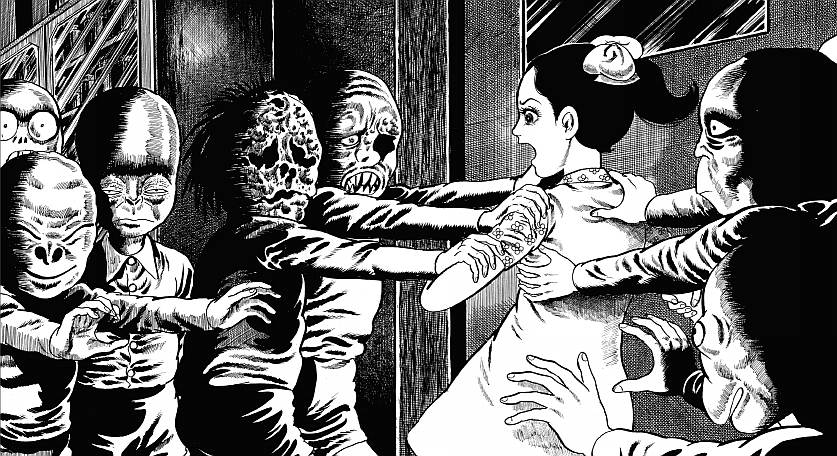
To make up for his trouble, I introduced him to Junji Ito’s Uzumaki (’Spiral’). The cover boasts ‘Terror in the Tradition of The Ring’, and I say to that - “Pish-tosh!” Because while Ring was a nice slow burn of a read as a book, and was terrifying as a film adaptation in Japanese, the manga version was not even something you could call horror - I would probably slot it into RL Stine-level, kid-friendly fare. Uzumaki - sigh - I tried reading volume 1 in my hotel room at around midnight, and about fifteen minutes later, I had to keep it aside and go reread the first few issues of Tomorrow Stories. That’s because the demented Mr. Ito and his finely inked panels wrought holy havoc on my dinner, and a little more of Uzumaki would have either (a) caused me to run to the bathroom and throw up every bit of undigested food in my tummy or (b) led me to toss and turn in bed with nightmarish visions floating in through the hotel balcony.

It is an undeniable page-turner, but there are times when you just know you gotta give up.

As embellishment to Mr Ito’s skills, here are three pictures of Vineet reading Uzumaki (in the daytime, of course) - observe the three stages, and note that the last picture was taken in a car, when we were off to drop him to the bus-stop and there was still a part of volume 3   remaining even as we made our way.

The Jon Brion Experience ( or how Palaka Sasidhar Rocked My LA Stay Part 1)

As the evening drew to a close, she bent close to me, her red dress sparkling under the lights, and spoke into my ears - “Ah, so you are a virgin?”

Wait, I get ahead of myself, like always.

A couple of weeks ago, I got reassigned to a new project, and the client’s office being in Los Angeles, they needed me there for some time, to meet the team and get acquainted with what it was exactly that I was supposed to do. Los Angeles, a city I had visited for 3 whole days two years ago, jazzing it up with pal Sasi and taking in landmarks that are etched in the minds of anyone remotely acquainted with film. Sunset Boulevard. Westwood Village. Hollywood. Mulholland Drive. Disneyland. Ok, not fucking Disneyland, I think I am too old for that. ( Says the guy who squeals like a baby when he sees a Sleeping Beauty snowglobe) But anyway, three weeks in Los Angeles! And this time, Sasi even had a car, and much more experience about what would float my boat during the stay.

“Jon Brion”, he asked me, a few days before I was to leave. “Do you know of him?”

Know Jon Brion? I heard Jon Brion’s music for the first time in 2005, when the soundtrack of Eternal Sunshine of the Spotless Mind melted my heart and my ears, and for a brief period of time in 2005, I went berserk and got a-hold of every Jon Brion soundtrack in existence. ( And this was a herculean task in a time when broadband speeds were still sub-64 kbps and Rapidshare wasn’t the searchable uber-repository that it is today ). Magnolia. Punch-drunk Love. I <3 Huckabees. It was humongously tough trying to find his earlier work, and I finally stopped with the Aimee Mann collaborations, which played in a loop for about a month on my Winamp playlist. It was a rush listening to her Brion-produced version of ‘One (is the Loneliest Number)’, that I had heard as a electronica/heavy-metal-driven cover by Filter on the X-Files soundtrack. It’s tough for anyone to call one single version of an oft-covered song as a definitive one, but I’ve heard multiple versions of ‘One’, and Brion’s organ-backed interpretation makes me feel all warm and fuzzy inside.

Of course, when Sasi asked me about Jon Brion, none of this really came up in my short answer. “Yes”, I said. “I love his music, but I haven’t really been following him after 2005.”

“You will probably enjoy watching him live”, Sasi remarked. “Let me see what I can do.” And I gotta say this about Sasi. He has this habit of understating stuff. After the first line, the “let me see” part nearly made me crush the keyboard. “You better do something about it, mate”, I said. And then my Indian-ness kicked in. “How much are the tickets?” And Sasi being the guy he is, he disappeared conveniently from Google talk, leaving me on tenterhooks for about a minute, but then I found out a new link on Twitter and forgot all about watching Jon Brion live. Being an ADD-monkey helps sometimes.

Jon Brion came up again when I landed. “We are going to Brion’s concert on Friday evening”, Sasi reminded me on Wednesday. “Wait, what? There’s a signing by James Jean at a store, do you think I can do both?” “In that case, we can do the concert next Friday.” Hmm, interesting. Turns out that Jon Brion performed every Friday at a club called The Largo, so it was not a one-off concert like I had thought. As things transpired, we landed at the Largo that very Friday, because the Jean signing turned out to be scheduled for the next weekend.

The club turned out to be very unlike what I envisaged it to be. The concert was held in a mini-theatre that could seat about 500 people, deep in the bowels of the location and away from the bar. It was already dark inside when we landed up, and most of the good seats appeared to be taken. ( “There are people who come every week”, said Sasi. “He plays a different set-list every time.” Ha, a far cry from Indian bands then. The one in Java City, Bangalore has been playing the same fifteen songs every Saturday the last seven years, or so I heard) We did manage to get a good view of the stage, and I watched people pour in even as the clock ticked closer to 9:30 PM. Someone named Alex had booked an entire row - and the complete entourage turned up precisely at 9:30, whooping and yelling - a birthday party, perhaps? The stage was lit moderately, and occasionally someone would turn up and tweak a knob on the sound-system, or carry a guitar and place it on a stand in front of the drums. On the left was a piano, and what looked like a Mellotron ( how do I know what a Mellotron looks like, you ask? The merits of Ent-quizzing, love) along with a number of small keyboards piled on the piano. The drums were in the middle, and there was a row of guitars of various shapes and sizes towards the right. Pleasant jazz played on the PA, and at about 9:35 PM, as the track that was playing came to a close (Did they time it according to the length of the song, I wondered), in walked Jon Brion, carrying a cup of coffee in his hand, to much cheering and applause.

“I need to finish this, or you folks will be listening to a lot of down-tempo stuff today evening”, he announced, cheerily, sipping on his coffee and sauntering around the stage, looking like he was making sure everything was in place. I waited for the drummers to enter, and the guitarist, when he sat on the piano and started playing this rollicking, honky-tonk-style melody. The auditorium was small enough for us to hear his feet stomping rhythmically on the floor, as he kept time, and the occasional gutteral “pah” that escaped his mouth. He was done, to much applause, and then jumped up and ran towards the drum kit. It was then I realized that Jon Brion would be playing all the instruments himself. I had heard that he was a multi-instrumentalist, but come on, even guys like that have backing musicians who switch instruments and let the star of the show take over for some part of the show. But not Brion, it seemed. He attacked the drums hesitatingly at first, and settled down into a pleasant groove that went a few bars, with rolls, flourishes and all, and then, as he leapt up, the drums, having been recorded, continued playing. He ran towards the piano, played a loop in synch with the drums, and this new piano-drum loop formed a new layer even as he ran towards the bass guitar and picked on a progression that added a new layer to the music. And then he sang, strumming on a guitar, and even that was connected to a processor that enabled him to layer the sounds one over the other. It didn’t sound like pre-recorded music at all ( well, except for the recorded drum sound, which did not hold a candle to what came from the kit when Brion played it) - what we were hearing was an organic, freshly-sculpted melody! This jigsaw-method of making live music continued for quite some time, as Brion raced across the stage, often humming a melody even as he played the drums one minute, raced to pick a guitar up, fiddled around with it for a bit and chucked it away in favour of another.  At times, he would stop everything and play a brilliant solo on the guitar, a hillbilly tune this instant, a blues melody in another.

Then came the audience-participation section of the show, which, according to what Sasi had told me, got mighty interesting. Brion asked for audience requests, and people exploded, yelling song- names at him even as he sat sipping his coffee. The girl sitting in front of me yelled “I am the Walrus!” Brion laughed - a peculiar sound that sounded like a combination of a bark and a sneeze, and began noodling about on the mellotron. “You guys need to sing along”, he said, as he got that precise violin sound out of the instrument. And we did - who doesn’t like singing along to a Beatles song, after all? -   and when we got to goo goo g’joob g’goo goo g’joob, he switched to a tuba sample, making it sound even more whimsical. A large number of audience requests were played, each more fun than the other - including a very very popular Bruce Springsteen song, a Kinks number - sadly, I do not remember most of the other songs. They did not allow photographs inside the Largo, so I do not have any pictures of how it all looked like. What totally got me was the way Brion was so, so relaxed and non-starry about performing in front of such an involved audience, and being able to perform without a rigid set-list at that.

The grand finale of the show came two hours later, a mind-bogglingly awesome mash-up of two videos, that of a pianist playing a tinkling melody, two women singing an acapella tune and a snippet of an orchestra playing. What Brion did was to slow a bit, and speed up others, change pitch, volume and phase to produce an eerie sonic effect that did not sound anything like the originals. He used that as a template for a song of his own, and gradually changed and shifted sound-palettes to create something quite unlike I had ever heard, part dissonance, part celestial harmony. Brion announced that there would be a second set, and this one would be even more intimate, it would be in the bar, and could seat only 50 people. Expecting a rush towards the venue, we hurried inside, but strangely, not many people seemed interested in the second set - what the fuck, LA people? - and we ordered our drinks and got ourselves nice seats. The music played this time was definitely more jammy, less loops and more spontaneous playing, both from Brion and from a session pianist who joined him. I forget his name, goddamnit, but he sang a song towards the end that gave me goosebumps.

As I was sitting there, a lady came in and joined the two people sitting next to me in the same row - and those guys seemed to have very strong impulses to go to the rest-room every now and then. She came and sat next to me then, and we looked at each other and smiled, acknowledging our mutual love of the music. When a song ended, she leaned closer to me and said - “Do you come here often?” “No”, I replied. “It’s my first time. I am not from around here.” The next song started just then, and the woman smiled, her red dress sparkling under the lights, and leaned a little closer. “Ah, so you’re a virgin.”

Not anymore, lady, not anymore.

Reallifeiffy

I am afraid the blog has fallen into the same trap as the ancient Livejournal. Namely, Reallifeiffy, a beast that slithers up my heels and wraps its tentacles around my fingers whenever I think of sitting down and talking about things I want to talk about. Reallifeiffy, like its distant cousin Dontwannamonkey, has this knack of casually whispering things of major and minor import into my ears, regardless of whether I want to hear them or not. “Stay away. Let me be”, I manage to sputter out. “I have stuff to write. Important stuff.” Reallifeiffy sighs languorously and tightens its grip a little. And then proceeds to remind me of books unread and half-read. Of devices named the PSP and the DS that that weep for my touch. It gently comments on the whirring sounds that my hard-drive emanates, the sound of billions and billions of zeros and ones that crackle with anticipation and wait to be consumed. It also draws my attention to the other stuff I have to write, the ones that appear in respected periodicals every month. It tugs at my eyelids, reminding me that I need to be at work early the next morning.

I am Reallifeiffy’s bitch. So are you, right?

We now leave the metaphor zone and enter a world of hedonistic delights. The question of the day is - “how much fun can you really have despite being down with fever for the better part of a week, and then catching a bad cold a week later, while the lady falls ill as well, and both being so behind on work that it is just not really funny anymore?”

The answer:

Goku! Bulma!

Akira Toriyama's Dragonball

Dragonball. The original anime, not the franchise-warming knock-offs that make appearances on geometry boxes and T-shirts. It’s 153 episodes in all, and I just finished watching the first fifteen. Yeah, it might be a little too early to make a judgement, but fuck that. I love Dragonball so far. Everything - right from the lush painted backgrounds to the wacky characters to the tripped-out concepts ( kamehameha!!! hoi poi pills!!! pee pee pee pee!!! ).

Goong

Goong

Goong. Which is the name of a Korean soap opera about a cute-in-a-Korean-way high school girl who gets married to the Crown Prince of South Korea. ( Yes, I know Korea does not have a monarchy, but this is an alternate history series as much as it is a romantic comedy) Kind of like Princess Diaries - the books, not the shitty movies - but with more palace intrigue and double-dealing. Though all of it is done in a very feel-good, grey-area way where you identify with every character and sympathize with everyone’s motivations. Every episode is an hour long, and 24 hours will eat up a substantial amount of my free time, but goddamnit, I regret nothing. Goong is a worthy successor to Witch Yoo Hee, the first K-rom-com-soap I saw - and My Girl is in the queue even as we speak, with the lady of the house singing its praises much eloquently ( she saw the 16-episode series when I slept, tired out by the fever)

Preacher

Preacher

Preacher, which I have begun to reread just because. Unbelievable how the series manages to stay so fresh even after countless rereads, Ennis’s dialog snapping and crackling on the page, each of the characters’ voices individually echoing in my head as I flip through the pages. ( That reminds me - Landmark Hyderabad had the complete trade paperback collection of the series for sale when I went there last, a day or two after it had opened. That was the first time I saw Preacher for sale in India.)

New comic art. Even as a long, long time payment got over a month ago, I had to figure out a way to get 8 new pages into the country without relying on any postal services. Nobody I knew was travelling, and there was a Mega-Important Trade Deal hanging in the balance. Yes, very unwisely, I had traded away two of the pages in the 8-page lot to get another, more important page from a European collector. It was a friend who helped bring the pages into the country, and yet another who transported them from Mumbai to Bangalore, and mailed them over to Hyderabad. If both of you are reading this, thanks a million, guys, and I know you will do this for me next time too, yes? A quick trip to DHL, where I sent off pages for the Mega Important Trade Deal, followed by a mind-bogglingly short wait - and there you go, another page has landed. The loot includes, among other things, a Preacher page ( which is part of the reason I began the series again), an Art Adams X-Men annual page from the 80s. Other items will be uploaded and gloated over later.

Stuff on my wall

Stuff on my wall

Old comic art, newly framed. The Long Time Payment was over; I was tired of flipping through my Itoya folders just to admire my pages from time to time, and the walls of our house look really bare, we decided to go get some key pages framed. Came out beautifully, though my wallet is still reeling from the sudden shock. The bulk of the black-and-white pages is in the living room, the two Japanese pieces you see above are in the area between the master bedroom and the study, and the mandala, the only non-comic art on the wall, is in the other bedroom. I cannot help feeling good everytime I see the Foster and the Williams DPS and the Goon and the Transmet page all together, woo hoo! Here’re pictures of all the comic art pages adorning the house.

So there you go, how’s that for an update?

A Hundred Things About Me ( Contd)

Part two of a vanity post to end all vanity posts. Part one here.

52. It’s very, very, very hard for me to stand still. I constantly shift from one foot to the other, if I am made to stand in one place. It’s worst when I am on a phone call and saunter around from one room to another, like an unstoppable clockwork soldier.

53. I suffer from ophiophobia. It began sometime in my early teens, got so bad that I could not open a book with pictures of snakes in it without feeling completely petrified. It’s come down in recent times, ( I would think it lessened because of the ridiculous Anaconda movies, which I watched without much effect) but I hate to think how I would react if I was on a flight and there were snakes on the plane.

54. I am also terrified when I am driving/riding behind a truck carrying iron bars that’re jutting out. Pretty common on Indian roads.

55. My weight fluctuated between 55-60 kilos until two years ago. I weigh about 80-85 kilos now.

56. For a long time, if I managed to obtain a book that I wanted to read really badly, I would think up ways to postpone reading it. Because if I finished it, there would be nothing else to read. It’s an irritating habit that persists even now, and it’s a constant struggle to convince myself that it’s ok - I can go ahead and indulge becaause there’s a shitload of stuff waiting to be read.

57. I am both a cat-person and a dog-person, with slightly more sympathy for cats because they are so misunderstood. We had two cats named Lobo and Simba, the first out of necessity, because our house was being overrun by mice, and the second one because we had no choice, Lobo just brought a kitten home one day and none of us had the heart to let it go.

58. The only time I’ve been vegetarian was for a whole year, when a rabid dog bit me and various herbal experts ( quack quack) advised my parents that I should not eat meat. It was a tough year, made a little better when three months later, the neighbour’s dog bit my sister and everyone in the family stopped eating meat.

59. When learning geography in high school, my brain refused to understand the concept of latitudes and longitudes until a friend made things clearer using a roundish potato and a knife.

60. I whistle somewhat differently from the normal way most of you do. Most of the time, you wouldn’t realize I was whistling because I don’t pucker my lips. Also, my whistle-pitch is somewhat different, which makes it impossible for me to whistle along with someone else.

61. In order to make myself look cooler, I started to memorize weird acronyms and abbreviations - KGB for Komitet Gozudarstevenonny Bezopasnosti, PT Usha’s full name, all the latin acronyms like NB and i.e. While this did come in handy in quizzes later on, I don’t think it fulfilled its original intent.

62. I created my first comic character when I was 9, a flying man named The Eagle.

63. I don’t like circuses. It’s all because of Target magazine, which did in-depth coverage of the cruel treatment meted out to animals in travelling circuses around India, and appealed to kids to boycott them.

64. I can’t dance, saala. Though lord knows I tried, especially at the height of Muqabla fever in the nineties. I could pelvis thrust continents into oblivion, but my hands and feet refused to move the way my brain told them to.

65. A rickshaw-puller bears witness to the first time I kissed someone. And that’s all I will say about that, other than clarifying that I was not kissing the rickshaw puller.

66. One thing I genuinely envy in some of my friends is their ability to quote verbatim from prose/poetry pieces. I can not, under any circumstances, repeat sentences word-for-word. This is partly the reason why I suck at cracking jokes - more often than not, I flub the punchline.

67. The Matrix and Kill Bill are two films that changed my movie and music tastes radically. A lot of interests - Japanese culture, anime, Ennio Morricone, noise-rock, Italian spaghetti westerns, Kung-fu/jidai-geki/wuxia films, electronic music - was sparked in some way or the other by these films.

68. The first film I remember seeing was ‘Andha Kanoon’ - I believe I was asleep in my mother’s lap in the theatre and I woke up when some lady was running around dressed in a police uniform. ( It was Hema Malini, and I like to believe the image resonated with me because I’d seen my father wearing the familiar khaki outfit. )

69. The one thing I shoplifted was an Edgar Rice Burroughs Tarzan novel that the bookstore was selling for 50 Rs, even though the official price at that time was 10 Rs, the difference arising because the former was an imported edition and the latter was an Indian reprint. I spent one summer blackmailed by a classmate at school with whom I had shared my secret, and who threatened to tell the teachers if I did not do his homework for him. ( Happy ending: he flunked that year, and changed schools. )

70. I have library-lifted once, and I am terribly ashamed about it, so let’s not bring it up again, yeah?

71. I don’t like rain. I am ambivalent towards summer. Winter is my favourite season. You get oranges in winter, that’s why.

72. When I am in pain, like if I stub my toe or run into a door, I say “aaargh” in my head. Not “aaa”, not “ooooooo” but “aaargh”. The only thing that differs is the number of a’s.

73. When my voice broke, I was really worried that I wouldn’t be able to sing along to Michael Jackson and Bryan Adams songs.

74. I tend to lose my temper far more often than I should, and at very frivolous things. Yes, I am unacquainted with what you earthlings call a “chill pill”.

75. One person I would like to meet before I die: Alan Moore. Another person I would like to meet before I die: Hayao Miyazaki. The first is vaguely possible, the second is unlikely.

76. On one particular occasion, I have sneezed 41 times non-stop.

77. The worst thing you can ask me to do is list out my favourites in any field. My answers will probably different depending on when you ask me.

78. I rarely contradict myself.

79. Actually I contradict myself all the time. Most of the time. Sometimes.

80. My favourite quizzing achievement was winning the Lone Wolf Quiz at IIT Madras, way back in 2001. It was my third time at Saarang and I made it to the finals almost by fluke, in a tightly-fought semi-final round.

81. There was a time I considered buying clothes an unnecessary evil, and relied exclusively on gifts from distant relatives, parents and the occasional gift coupon won at quizzes to buy my clothes. I like to believe I’ve evolved a bit since then.

82. I spent years trying to design the perfect cardboard boomerang. One that would actually return to my hands once I threw it, instead of falling into a sewer or getting lodged in a tree or landing on the roof of the house.

83. Personally, I think panipuri is the greatest thing Indian civilization has offered to the world.

84. For a long time, I was confused between a protractor and a divider in my geometry box.

85. I have broken a door and a shelf ( which is referred to in my part of the country as a “show-case” ) trying to skateboard inside the house. The skateboard, of course, was self-built, using a piece of wood and three ball-bearings. It made an ungodly sound if I tried it on the road and I thought it more prudent to hone my expertise away from curious eyes.

86. I can play complicated rhythms on wooden surfaces, using my fingers. Many of you might scoff and say there’s nothing to it, but I am really good at it, honest. I try out the acoustics of any new wooden surface I encounter by tapping out a beat.

87. Among the things I’ve written and will never share with anyone else - a prequel to Sholay, an epic retelling of a failed love story in my college days, and a porno version of a part of the Mahabharata. In fact, I think two of them might be irretrievable - I burnt one of them in a folder in a game collection, and there was a virus on one of the games and I threw the disc away, and the other is in a protected zip file, and I’ve forgotten the password.

88. The first website I visited in my life was www.spawn.com. Ah, the follies of youth.

89. I used to be really terrified of chronic insomnia. Yes, because of the Stephen King book. So I made it a point to get my share of daily sleep regardless of where I was and what I was doing. I made it through my college life without a night-out - I would inevitably fall asleep around three thirty in the morning. Then I worked in a project where the rest of the team members worked from the USA and I found it more convenient working throughout the night. For six months, I would work from five in the evening to six in the morning, and then have breakfast at seven and sleep till three. It was an amazing experience, and needless to say, I no longer have my fear of insomnia.

90. Because I’ve never bought a house or a car, I have never had to pay EMIs. But I have made monthly payments for comic art, though; the longest period of time has been 2 years of straight instalments. It gets over this month.

91. I can sing in languages that I do not know. Tamil, for example. Also, Spanish, Finnish and Japanese. I can also sing Mile Sur Mera Tumhara by heart, and it has 14 languages in it.

92. I have a very very irritating laugh. It has provoked people to violence more than once, and over the years, I’ve learnt to modulate it enough, I think.

93. I cannot bring myself to watch television for more than a few minutes at a time. Ad breaks kill my interest in anything that I am trying to watch. The TV shows I like, I would rather watch on DVD, one seasonful at a time.

94. One near-death experience I’ve had - a narrow hilly road, a downhill slope, a truck hurtling down the road, and I decide to run across to be with my father, who was getting some tea and biscuits for us in a small shop on the other side. It was when we were moving from Karimganj to Tezpur, I was 6, and I still remember my mother screaming at me not to run, and my father slapping me really hard after I survived the dash.

95. My general attitude towards new technology - any new technology -  is analogous to that of a kid about to dip into a swimming pool at five AM on a winter morning. 

96. I have this earnest, I-am-listening-to-you look on my face during meetings, lectures and presentations, which I punctuate with occasional nods and smiles. Maybe it is because I feel very nervous while speaking in public, and become very gratified when someone is paying attention. The downside of this habit is that the presenter tends to look at me very pointedly throughout the bulk of the talk/lecture, which means I need to pay attention throughout. I am still not sure if that’s a good or a bad thing.

97. The first time I boarded a plane in my life was with my own hard-earned money. In 2002, when I made my first trip back home after getting a job.

98. One of the things I would like to do is organize India’s first comic-book convention. But I think I am too lazy to do anything about it, and someone else will probably beat me to it. 

99. I am very, very, very hesitant to catch up with old friends who I haven’t met in a long time. It could be because I have a golden-haloed view of the past, and that makes me whitewash my memories of friends and acquaintances. It could also be because, after having met a few folks from my past, I realized that ‘real life’ had made them very different from what I envisaged them to be ( they thought the same thing about me, probably), resulting in banal conversations and a half-hearted attempt to exchange phone numbers. 

100. Meta Fact: I loved making this list, even though it took me a very very long time to write it. This shows that like nearly everyone else, I love talking about myself. It also tells me how much of myself I am willing to talk about on a public page - obviously, I deleted and redid a lot of  stuff just because I thought it would be giving too much of me away. Yep, I guess I like the illusion of being a private person. Whatever.

←Older